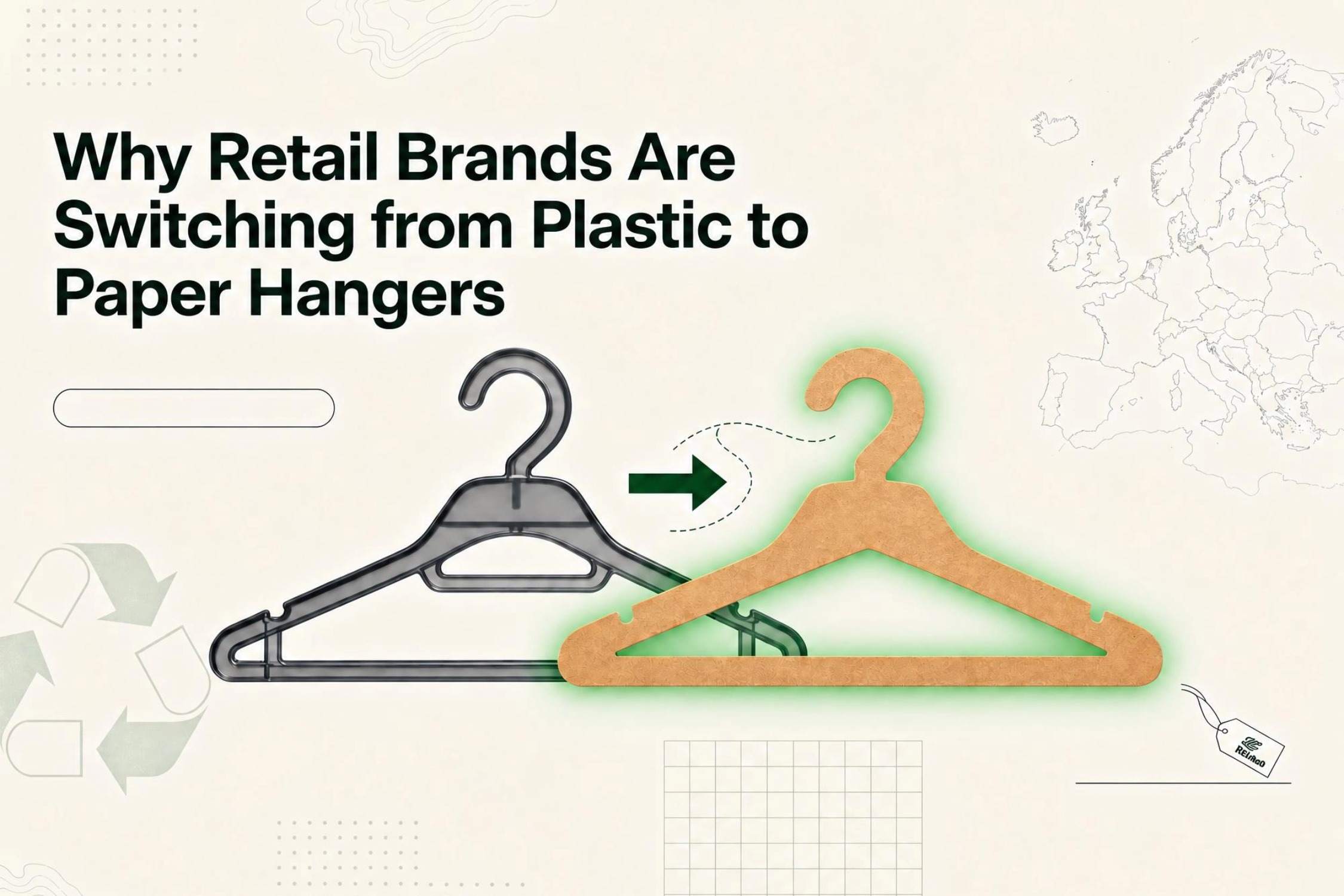
Why Retail Brands Are Switching from Plastic to Paper Hangers
Aug, 17 2026
Sustainability as an Operational Decision
Sustainability has moved out of the marketing team and into procurement. The decision to reduce plastic now affects sourcing, supplier evaluation, and in-store presentation, rather than appearing only in brand communications. Hangers sit at the center of that shift because they remain visible throughout the retail cycle. Unlike inner packaging, which disappears after purchase, a hanger is handled by staff and customers every day. Changing it to paperboard makes the brand's position on plastic tangible.
Runhee has been manufacturing paperboard hangers since 2010, long before sustainability became a mainstream procurement requirement. That early focus means the production process, material sourcing, and structural engineering are already established — not newly assembled in response to a trend. For brands making the switch now, working with a manufacturer that has already delivered over 1.2 billion paper hangers removes much of the trial-and-error risk.
Regulation Is Accelerating the Shift
Policy pressure is now moving faster than consumer preference. European markets, in particular, are extending plastic restrictions beyond bags and straws into retail accessories. France, Spain, and Italy have introduced or announced measures targeting single-use plastic in retail environments, and the EU's Packaging and Packaging Waste Regulation is pushing brands to rethink every plastic touchpoint — including hangers. For a brand managing supply across several countries, each new rule adds complexity to a plastic hanger program.
Recycled paperboard products face fewer cross-border complications and align more easily with existing waste and recycling frameworks. Moving early removes a level of uncertainty that is likely to grow, not shrink. Runhee supports brands across Europe, North America, the Middle East, and Southeast Asia with FSC and GRS certified materials, helping them meet retail compliance requirements before they become mandatory.
Consumer Perception and Brand Consistency
There is also a customer-facing dimension. A brand that talks about environmental responsibility but hangs its garments on plastic can look inconsistent, and shoppers now notice those contradictions. This is especially true among younger audiences who share store observations online. A paper hanger closes the gap between what a brand says and what a customer physically touches. That kind of consistency builds trust without additional advertising.
Major retail groups have already made public commitments. Primark announced its goal to eliminate single-use plastic by 2027, and several other European and UK retailers have set similar timelines. These commitments are not marketing statements — they are operational targets that suppliers are expected to support. For brands selling into these retailers, paper hangers are becoming part of the supplier qualification process, not just a product preference.
Supply Chain Readiness Has Caught Up
Practical sourcing concerns have also faded. Production of paperboard hangers has expanded significantly, particularly in China, and order volumes that were once difficult to place are now standard. Lead times are more predictable, and factories have moved toward automated production. The earlier supply-side limitation that pushed paper hangers into a niche no longer applies for most retail buyers.
Runhee operates in-house die-cutting, printing, and testing facilities in Dongguan, with a material library covering kraft, white coated, and black coated paperboard. Standard sampling takes around 15 working days, and bulk production runs 15–25 working days after approval. For brands that need to test the market before committing to large volumes, MOQ starts at 2,000 pieces, with a 500-piece trial option available.
Moving Early Is a Competitive Advantage
Adopting paper hangers now is not just a compliance response — it is a positioning move made before the rest of the market catches up. Early movers have more influence over design, pricing, and supplier relationships. Because paper hangers are die-cut rather than injection molded, custom shapes do not carry the high tooling costs associated with plastic. Brands can develop distinctive silhouettes, test different structures, and adjust designs without being locked into one fixed format.
For a closer look at how paper compares with plastic in actual retail use, it helps to see the two materials evaluated side by side: Paper Hangers vs Plastic Hangers: A Complete Comparison for Retailers.